How Do I Know If a Painting Is Worth the Price?


One of the hardest questions for someone buying original art is also one of the most reasonable: How do I know if a painting is worth the price?
It’s a question I understand. When you’re considering spending several hundred or even several thousand dollars on an original painting, you want to feel confident that you’re making a good decision. Learning how to evaluate original art means looking beyond the price tag. There are practical things to consider, such as the materials, craftsmanship and the artist’s experience, but there is also something much more personal: whether the painting speaks to you and has a meaning you’ll continue to value over time.
But art is difficult to measure. You can't compare two paintings the way you might compare two appliances, looking at the size, materials and specifications and deciding which one gives you more for your money. And you certainly can't decide what a painting is worth simply by calculating how many hours an artist spent making it.
There are things that contribute to the price of an original painting. Materials, craftsmanship, experience, originality, an artist's career and the quality of the individual work all matter.
But after many years of painting, I think there is another question that may be even more important: Is this painting worth living with?
For me, that is where the conversation about value really begins.
A Painting Isn't Priced by the Hour
One of the first things people sometimes wonder is how long a painting took to make.
It seems logical. If an artist spent 40 hours on a painting, surely it should cost more than one that took 10 hours.
But painting doesn't work that way.
Some paintings take a long time to resolve. Others seem to come together almost unexpectedly. Sometimes I can work on a painting for days, stepping back, changing something, taking something away and trying to understand what isn't quite working.
Other times, the decisions seem to come so easily.
After years of painting, I've learned that the paintings I am happiest with aren't necessarily the ones that took the longest. Time in the studio is important, but so is everything the artist has learned before that painting ever begins.
Years of looking, painting, making mistakes and learning what to leave alone become part of the process too.
The same is true of materials. When I paint, I care about using good quality materials and preparing a painting properly because I want the finished work to last. The canvas or panel, oil paints, mediums, varnish and preparation all matter.
But good materials don't make a good painting. They give the artist a good foundation to work from. The painting itself still has to succeed.
Experience Matters, But It Isn't Everything
It is reasonable for a collector to be curious about the artist behind the painting.
How long have they been painting professionally?
Have they developed a recognizable body of work?
Are they continuing to grow?
Have they exhibited with galleries or established art organizations?
Are their paintings consistently well made?
These things give you context.
An artist's career development and gallery representation can also help you understand where they are professionally. Being represented by a gallery, exhibiting regularly, receiving recognition for your work and building a history of collectors can all be meaningful indicators of an artist's professional development.
But none of those things should replace looking at the painting itself. An artist can have an impressive résumé and still make a particular painting that doesn't speak to you. And an artist who is still developing their career can make a remarkable painting.
The individual painting matters.
That is something I think collectors sometimes forget when they become too focused on names and reputations.
Look at the Painting Before You Look at the Price
If you are considering buying an original painting, spend some time looking at it before thinking about whether it is a "good investment" or whether the price seems high.
What happens when you look at it from across the room?
Where does your eye go first?
Does the composition hold together?
How are the colours working with one another?
Is there depth?
Is there atmosphere?
Does the painting have energy?
Look closely at the paint. Can you see the artist's decisions in the brushwork? Are there areas that are quieter and others that carry more weight?
Then step back again.
A good painting needs to work at different distances.
These are the things I think about when I am painting my own landscapes. I am not simply trying to reproduce what I see in front of me. I am making decisions about what to emphasize, what to simplify, where to put the strongest colour and where to let the painting breathe.
The goal isn't to include everything. It is to make the painting work as a whole.
Originality Matters Too
When you look at an artist's work over time, you should begin to see a point of view. That doesn't mean every painting should look the same. In fact, I think the opposite is true.
An artist should be able to explore different places, seasons, light and ideas while still having something that connects the work.
For me, that connection comes from the way I see the Canadian landscape.
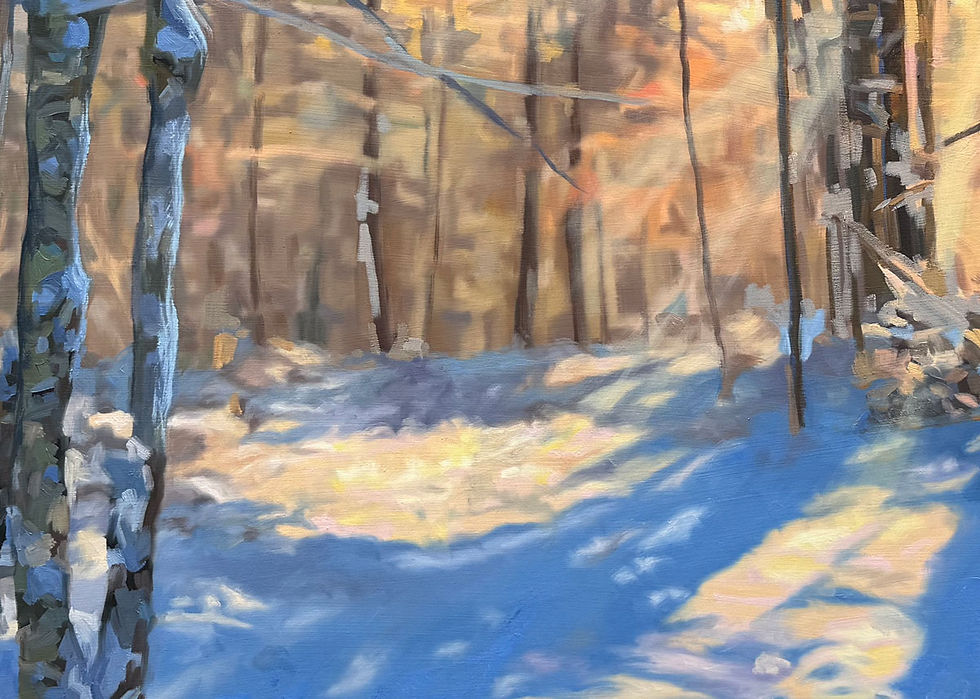
I am drawn to the quiet moments. Water reflecting light. A stretch of shoreline. The feeling of being surrounded by trees. The changing light at the end of a summer day. The familiar landscape that suddenly looks different because the light has changed.
Those are the things that keep me coming back to paint.
Over time, those choices become part of an artist's visual language. That is what I mean by consistency. It isn't about producing paintings that all look alike. It is about developing a recognizable way of seeing.
What Are You Actually Paying For?
When you buy an original painting, you aren't simply paying for a piece of canvas covered in paint. You are buying the result of years of looking, learning and practicing...the artist's decisions.
You are buying the physical object itself, including all of the things that cannot be reproduced exactly in a print such as the brushwork, the texture of the paint,the subtle changes in colour, the decisions that were made and the ones that were deliberately left out.
There is only one original.
A reproduction can give you the image, but it doesn't give you the actual painting. That distinction is important. There is something very different about standing in front of an original painting and seeing the physical evidence of how it was made.
You Don't Need to Be an Art Expert
I think one of the biggest misconceptions about buying original art is that you need to know a lot about art before you can become a collector. You don't.
You don't need an art history degree. You don't need to know the difference between every painting style. And you don't need someone else to tell you what you are supposed to like. You do need to learn to trust your own response.
Do you keep looking at the painting?
Does something about it stay with you after you've walked away?
Does it remind you of somewhere you know?
Does it bring back a memory?
Does the colour make you feel something?
Can you imagine seeing it every morning and still noticing it years from now?
Those questions matter. In fact, I would argue that they matter more than whether someone else thinks you made the "right" choice.
A Beautiful Painting May Still Not Be Your Painting
There is another thing I think collectors should give themselves permission to do. You can look at a painting and recognize that it is beautifully made without wanting to own it. That is perfectly okay.
Art is personal. A painting can have excellent craftsmanship, a strong composition and an accomplished artist behind it and still not belong in your home.
And the reverse is also true. You may find yourself drawn to a painting that someone else walks right past. Perhaps it reminds you of a place where you spent your summers. Perhaps the colours remind you of a particular season. Maybe there is simply something about it that you can't quite explain.
That is part of collecting. Your collection should have meaning to you.

Don't Compare Paintings Like You Compare Appliances
I think this is where the idea of value gets particularly interesting. If you are comparing two refrigerators, you can look at their features and make a fairly objective comparison.
Art doesn't work that way. Two paintings can be the same size and use similar materials and have completely different prices. One artist may have been painting professionally for decades. Another may be earlier in their career.
Those things provide context. But they don't tell you how you will feel about the painting six months from now. Or five years from now. That is why I don't think the question should simply be, "Is this painting expensive?"
A better question is: "What will this painting give me in return?"
So, Is It Worth the Price?
There isn't a formula. Materials matter. Craftsmanship matters. Experience matters. Originality matters. An artist's career development and gallery representation can provide useful context. And the quality of the individual painting matters enormously. But once you have considered all of those things, I think there is still one question left.
Do you want to live with it?
That question has become increasingly important to me as I have thought about what it means to collect original art.
A painting becomes part of your home. You see it when you walk into the room. You may notice it while having your morning coffee. You may walk past it hundreds of times without really looking, and then one day the light catches it differently and you stop. Over the years, the painting can become connected to the life you are living around it.
It could remind you of a favourite lake, bring back a summer spent at the cottage, or it might give you a few quiet moments every time you look at it.
That is the kind of value I think about when I paint the Canadian landscape. I don't want someone to buy one of my paintings simply because it fills an empty wall or because they think they should own an original Canadian landscape painting.
My hope is the painting will make them pause.
I want them to recognize something in it that feels familiar, even if the exact place isn't.
It could be the light on the water, the feeling of standing at the edge of a forest, the quiet of an early morning at the lake, or maybe they simply love the painting.
Price is something you pay once. The value of a painting is what it continues to give you after you bring it home.
That, to me, is what makes a painting worth living with.


Comments